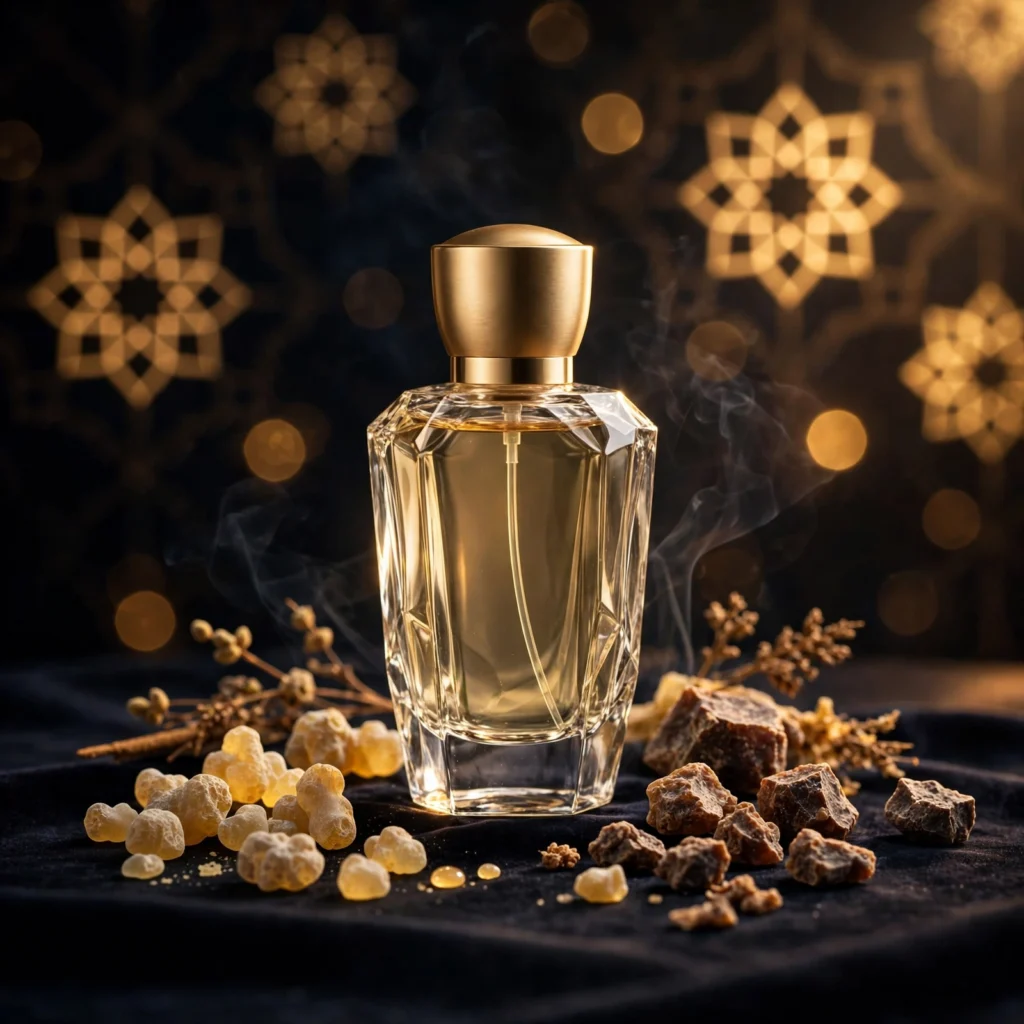
Frankincense & myrrh appear in every UK primary school nativity play, gifts carried by the Magi. What is rarely explained is that both are resins from the same family of aromatic trees that underpin Arabian perfumery, and their presence in a story about a Middle Eastern birth is not a coincidence — they were, quite literally, perfume.
Table of Contents
What Frankincense & Myrrh Actually Are
Frankincense (olibanum) is a resin tapped from Boswellia trees, native to Oman, Yemen and the Horn of Africa. Myrrh comes from Commiphora trees in similar regions. Both were historically burned as incense or blended into oils — the same basic principle behind bakhoor today. Frankincense & myrrh remain the archetypal Arabian resins — once you can pick out their dry, churchy sweetness, you will start noticing them (or their synthetic cousins) across a whole family of Arabian and Western niche perfumes.
How Frankincense & Myrrh Are Harvested
Harvesting is slow, skilled work. Cuts are made in the bark of Boswellia or Commiphora trees, and the resin that seeps out is left to harden into tear-shaped lumps over several weeks before being collected by hand. A single tree yields only a modest amount per season, and the best grades — pale, clean tears with a strong aroma — have always commanded the highest prices. It is essentially the same process today as it was two thousand years ago.
Why They Were as Valuable as Gold
In the ancient world, frankincense and myrrh travelled thousands of miles along overland incense routes from southern Arabia to the Mediterranean, making them genuinely comparable in value to gold by the time they reached a Roman market — scarcity and distance, not rarity of the tree itself, drove the price. This is the economic reality behind frankincense & myrrh: luxury goods defined by the journey, not just the material.
The Direct Line to Arabian Perfumery Today
Resinous, incense-like notes remain a defining feature of Arabian perfumery, sitting in the same olfactory family as amber and oud. When a modern perfume is described as having a “churchy” or “incense” facet, it is often quite literally drawing on frankincense or a frankincense-like note.
Frankincense & Myrrh in Modern Arabian Perfume
Modern Arabian perfumes built around frankincense & myrrh often pair these resins with musk, amber or oud to soften their sharp, incense-like edge. Fragrantica’s page on musk as a perfumery note explains how this base note works in such blends. If you want to smell the connection for yourself, look for Arabian perfumes with a listed frankincense or “olibanum” note — the church-incense facet is unmistakable once you know what you are smelling.
A Christmas Connection Worth Knowing
The Christmas story’s gifts were, in effect, luxury Arabian perfume ingredients — a genuinely useful bit of context if you are choosing a resinous, incense-leaning scent as a UK Christmas gift this year. Frankincense & myrrh were not symbolic trinkets; they were among the most valuable portable goods in the ancient world, which is rather the point.
FAQ
Is frankincense the same as oud?
No. Frankincense comes from Boswellia trees and oud from infected Aquilaria agarwood, though both are resinous and often grouped in the same incense-like fragrance family.
Why were frankincense and myrrh so valuable in the ancient world?
They had to travel enormous distances along overland incense trade routes from southern Arabia, making transport cost rather than tree rarity the main driver of price.
Is frankincense used in perfume today?
Yes, it remains a common note in modern perfumery, particularly in resinous, amber-adjacent and “incense” facing fragrances.
Curious about resinous, amber-forward scents? Read our amber vs oud guide.
Related reading: our guide to the best incense perfumes in the UK for 2026.