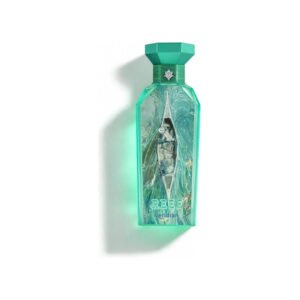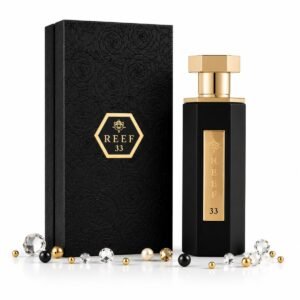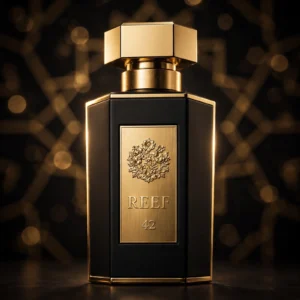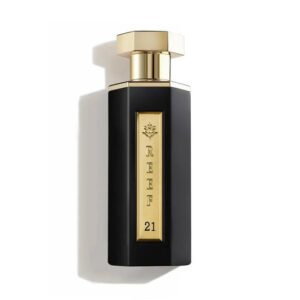
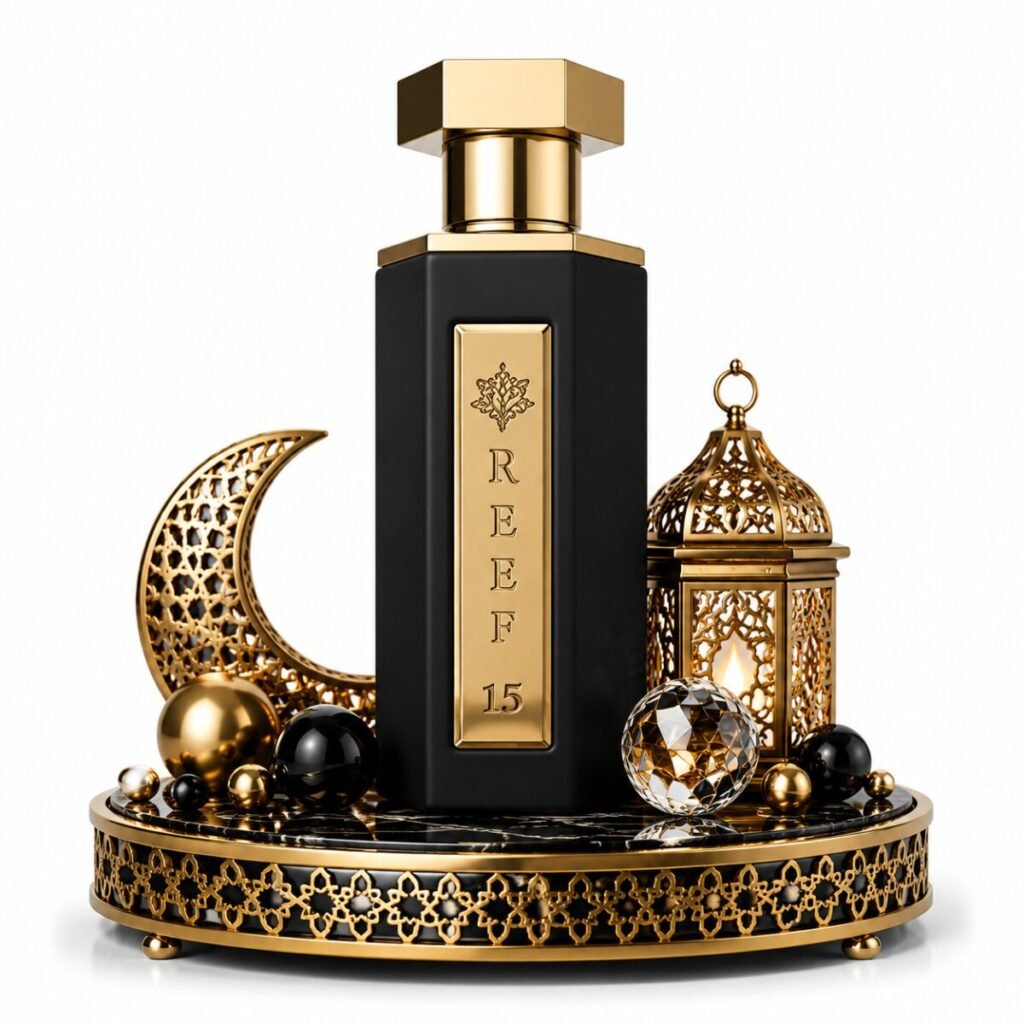
Reef is one of the most wanted Arabic perfume houses in the UK — and that is exactly why fakes exist. Reef 33, the most searched Reef scent in the UK, is currently out of stock at Arabic Aura, so buyers who cannot find it from an authorised stockist go looking elsewhere. Reef is not stocked in mainstream UK department stores, so most buyers meet the brand online, through a seller they have never dealt with. High demand, limited official channels, online-only buying — that gap is where fake Reef gets sold.
Most fakes give themselves away. This guide walks through nine checks, in the order to use them: before you buy, when the parcel arrives, and after the first spray. Some are facts you can verify; others are warning signs, and the guide says which is which — a warning sign is not proof, and treating one as proof is how genuine bottles get wrongly condemned and good fakes get wrongly trusted.
The 9 checks
Check 1: The price — compare it with the real range
What you can verify: every in-stock Reef Eau de Parfum at Arabic Aura costs £42.99 — Reef 31, Reef Obaiah, Reef 33 White, Reef 21, Reef 11 and Reef 19 are all 100ml bottles at £42.99, and the two 150ml bottles (Lady Reef and Reef Pure Fruity) are £42.99 as well. That flat price is the real UK range for Reef at an authorised stockist.
The warning sign: a listing far below £42.99. A Reef 100ml at £15 or £20 from an unverified seller is not a bargain — it cannot have come through authorised distribution at that price. Legitimate sales and clearances do exist, and a genuine retailer can discount stock, but a persistent, dramatic discount on a popular scent from a seller with no track record is a red flag, not an opportunity. A price far above £42.99 proves nothing either — some sellers inflate prices to look premium. Price alone never proves anything; it tells you how hard to look at the other eight checks.
Check 2: The seller — vet them before you pay
What you can verify: whether the seller states, clearly and in writing, where their stock comes from. Arabic Aura states on every Reef product page that every bottle is “100% authentic, sourced directly from authorised Reef Perfumes distributors” — a checkable claim, backed by a real business name, UK address, contact details and returns policy.
The warning sign: vagueness. A seller who will not say where their stock comes from, who has no UK address or contact details, whose listings use stock photos that do not match the bottle described, or who offers the same fragrance at wildly different prices across listings, is asking you to trust them with nothing to trust. UK buyers are already searching for this: “reef unauthorized retailer” is a query people are typing into Google. If a seller cannot show they are authorised, treat them as unauthorised.
Check 3: The packaging — print, spelling and finish
Warning signs, not verified Reef facts: no published source we could verify describes Reef’s exact packaging specifications, so there is no official Reef packaging checklist to compare against. Apply the general checks that catch most fakes across all perfume brands. Genuine packaging has sharp, clean printing; fakes often show blurred text, spelling errors, or colours slightly off. The brand and scent names should be spelled correctly, with consistent fonts between box and bottle. The card should feel substantial, folds crisp, and any seal flush without obvious peeling.
Poor wrapping alone proves nothing: genuine stock can be damaged in transit, and good fakes can be wrapped well. Treat packaging as one signal among nine, never the verdict.
Check 4: The batch code — match it, don’t “verify” it
What you can verify: the batch code on the box should match the code on the bottle, and look professionally applied — printed or etched as part of the packaging, not smudged, stickered over, or missing. A mismatch is a serious red flag.
What you cannot verify — and this matters: Reef publishes no public batch-code checker that we could find. There is no official Reef tool where you type in a code and get a yes or no, and no published Reef batch-code format to compare against. Third-party checker websites exist for perfume in general, but their databases are incomplete, they only decode a manufacturing date at best, and a result cannot prove a bottle genuine — counterfeiters can copy a genuine code onto a fake bottle. So if a seller claims they can “verify” a Reef batch code for you through some official tool, or points you to a checker as proof, that claim itself is a red flag. The batch-code check is the match between box and bottle, and whether the code looks professionally applied. That is the whole of it.
Check 5: The bottle — weight, finish and spray
Warning signs: pick the bottle up. A genuine Reef bottle has a satisfying weight; fakes often feel light or hollow, with thin or cloudy glass. Look at the finish — clean edges, even coating, a cap that fits properly. Test the atomiser: a genuine bottle produces a fine, even mist, while a fake may sputter, dribble or stream. Check the tube inside reaches sensibly toward the bottom and is not excessively curled or too short — a detail counterfeiters often get wrong.
Compare the bottle with the product photos on an authorised retailer’s listing. If the shape, proportions, cap or label differ from the genuine bottle photographed there, ask why before you buy. Bottles can vary slightly between production runs, but an unexplained difference plus any other warning sign should stop the purchase.
Check 6: The juice — smell it, and time it
What you can verify: genuine Reef Eau de Parfums are formulated for real longevity. Reef 31’s own product page publishes 6–8 hours of wear, Reef 11’s page publishes around 6–7 hours, and Reef Pure Fruity’s page publishes 8 hours or more. Those figures are for those specific scents — longevity varies across the range.
The warning sign: a bottle that fades within an hour, or smells noticeably thin, flat, sour or harshly alcoholic for its described composition. A strong blast of rubbing alcohol in the first seconds, or a scent that smells like vague soap with no recognisable notes, points to diluted or counterfeit stock. But a single sniff is not a verdict: skin chemistry, temperature and even a cold can change how a genuine perfume smells. The strongest juice check is a side-by-side comparison with a bottle you know is genuine. If you do not have one, combine the juice check with the other eight: one weak signal is a question, three together are an answer.
Check 7: The box — read it like a label, not a decoration
What you can verify: the box should agree with the bottle and with the listing. The scent name, size (100ml or 150ml), concentration (Eau de Parfum) and brand name on the box should match what you ordered and what is printed on the bottle, and the barcode should be clearly printed. Compare the box with the product photos on the authorised retailer’s listing — layout, colours and text should match.
Warning signs: spelling mistakes, distorted logos, mismatched fonts, or details that contradict the listing — a different size, a different scent name, missing information. Also check the batch code on the box is present and matches the bottle (see check 4). A missing box is not automatic proof of a fake — some genuine stock is sold without one — but a seller offering “new, boxed” Reef with no box, or a box that disagrees with the bottle inside it, owes you an explanation.
Check 8: The returns policy — read it before you buy
What you can verify: Arabic Aura offers a 14-day returns policy on its Reef range, stated on every Reef product page alongside free UK delivery. A clear, written returns window is what a retailer confident in its stock offers.
The warning sign: a vague, non-existent or unusually restrictive returns policy. “No returns on perfume”, “returns at our discretion only”, or no returns information at all limits your recourse if the bottle turns out to be fake — and a seller who knows their stock is genuine has no reason to hide behind that. Check the returns policy before you pay, not after the parcel arrives. Also check the seller has a real customer-service route — an email or phone number that is actually answered — not only a contact form that goes nowhere.
Check 9: The payment — keep your protection
What you can verify: paying by credit card gives you a route to a dispute if the bottle turns out to be fake. Under UK consumer law, a credit-card purchase gives you Section 75 protection on purchases between £100 and £30,000.
The warning sign: a seller who insists on bank transfer, gift cards, cryptocurrency, or “friends and family” payment. Those routes give you no chargeback and no buyer protection — a seller who will only accept them is removing your only safety net. A genuine retailer has a normal checkout with card payment. If the deal is only available by bank transfer, it is not worth it, whatever the price.
What to do if you bought a fake
If several checks point the same way, act in this order.
1. Contact the seller first. Explain the problem specifically — which checks failed and how — and request a return or refund. A legitimate seller will want to put it right, and a clear, specific complaint is harder to dismiss than “I think it’s fake”. Keep the bottle, box and packaging, and do not use the bottle further once you have decided to dispute it.
2. Raise a payment dispute. If the seller refuses or stops replying, open a dispute with your card provider, with the evidence: the listing, what you paid, the failed checks, and photos of the bottle and box. Disputes have time limits, so do not wait weeks.
3. Use marketplace protection if you bought through one. Marketplaces such as eBay and Amazon have buyer-protection policies covering counterfeit goods. Report the listing as counterfeit too — it protects other buyers.
4. Report the seller in the UK. You can report a counterfeit seller to Citizens Advice, who can refer your case to Trading Standards. Keep copies of everything: the listing, order confirmation, messages, and photographs of what arrived.
5. Do not resell it. Passing a bottle you believe is fake on to someone else, even at a low price, puts you in the wrong. Dispose of it once any dispute is resolved.
Where to buy authentic Reef in the UK
The simplest way to avoid every check above is to buy from an authorised stockist. At Arabic Aura, every Reef bottle is sourced directly from authorised Reef Perfumes distributors, sealed and batch-coded, with free UK delivery and a 14-day returns policy. All six men’s and unisex picks below are in stock at £42.99:
- Reef 31 — £42.99, saffron, amber and vanilla, 6–8 hours published wear
- Reef Obaiah — £42.99, pineapple, leather and oud
- Reef 33 White — £42.99, red berries, saffron and oud — the closest in-stock alternative to Reef 33
- Reef 21 — £42.99, red berries, cedarwood and patchouli
- Reef 11 — £42.99, pink pepper, jasmine and sandalwood, around 6–7 hours published wear
- Reef 19 — £42.99, lily of the valley, jasmine and white musk
Reef 33 itself — Indian saffron, rosemary and agarwood oud, the most searched Reef scent in the UK — is currently out of stock at Arabic Aura, priced at £42.99 when available. That is why it is the most faked Reef scent right now: buyers who cannot find it from an authorised stockist go looking elsewhere. If you see Reef 33 offered far below £42.99 while it is out of stock everywhere legitimate, run all nine checks before paying. Read our Reef 33 review and our best Reef perfumes for men guide for the full picture on the range.
For the same checks applied to other houses, see our how to spot fake Khadlaj perfume guide and our general guide to spotting fake Arabic perfumes.
Pressure tactics: “last one”, “DM before it goes”
Beyond the nine checks, watch how the seller talks to you. Fake sellers use urgency to stop you checking: “last one in stock”, “price goes up tonight”, “DM me before it goes”, “I have three people asking”. A genuine retailer with real stock does not need to rush you past the checks in this guide — the bottle will still be there after you have verified the seller, the price and the returns policy. Urgency is not proof of a fake on its own, but urgency combined with any failed check is a reason to walk away, not to pay faster.
Gifting: checking a bottle without spoiling the surprise
Checking a gifted bottle is awkward, because opening it ruins the gift. You can still verify most of it without breaking the seal: compare the box print, spelling and finish against a genuine Reef box; check the batch code is printed cleanly and matches the format on the base; weigh the sealed box in your hand — fakes are often noticeably lighter; and keep the receipt and the seller’s details until the bottle has been opened and worn. If anything feels off, return it sealed under the seller’s returns policy rather than opening it to check — an opened bottle is much harder to return.
Second-hand Reef: buying pre-owned
Pre-owned Reef carries risks a sealed bottle does not. There is no returns policy on most private sales, the fill level may be lower than stated, and a used sprayer can have been refilled with something else entirely. If you buy pre-owned, ask for photos of the batch code on both box and bottle, a photo of the fill level against light, and the seller’s reason for selling. Pay through a protected route, never by bank transfer. And remember the juice check from Check 6 matters even more here: a pre-owned bottle that smells weak or wrong in the first hour is almost certainly not worth disputing over — it is worth not buying in the first place.
Frequently asked questions
Is cheap Reef perfume always fake?
No — legitimate sales and clearances exist. But a Reef 100ml listed far below the £42.99 authorised price, particularly by an unverified marketplace seller with no returns policy, carries a meaningfully higher risk of being counterfeit or diluted. Price is a warning sign, not a verdict: combine it with the seller, packaging and batch-code checks.
Can I verify a Reef batch code online?
Not through any official Reef tool — Reef publishes no public batch-code checker that we could find, and there is no published Reef batch-code format to compare against. Third-party batch-code websites can at best decode a manufacturing date, and their databases are incomplete; a result cannot prove a bottle genuine, and counterfeiters can copy a genuine code. What you can verify is that the code on the box matches the bottle and looks professionally applied. A missing or mismatched code is a warning sign; a matching code is a pass on one check, not a certificate of authenticity.
How can I verify a UK retailer sells genuine Reef perfume?
Look for three things together: a clear, written statement that they source from authorised distributors; consistent packaging quality across their listings; and a reasonable returns policy. Arabic Aura states authorised-distributor sourcing on every Reef product page and offers 14-day returns with free UK delivery.
What should I do if I think I bought a fake?
Contact the retailer’s customer service first, explain exactly which checks failed, and request a return or refund — the five steps above walk through the rest, including a payment dispute, marketplace protection, and reporting the seller to Citizens Advice for referral to Trading Standards. Keep the bottle, box and all paperwork until the dispute is resolved.
Does Reef perfume have a serial number I can check?
There is no published Reef serial-number system or official verification tool that we could verify. Reef bottles carry a batch code on the box and the bottle; the check is whether the two match and look professionally applied — not whether the code matches some published pattern, because none is published. Any seller claiming to “verify” a Reef serial number through an official system is making a claim we cannot substantiate.
Why is Reef 33 the most faked Reef scent?
Because it is the most wanted and the hardest to buy legitimately: the most searched Reef scent in the UK, and currently out of stock at Arabic Aura. Counterfeiters target the scent buyers want most and cannot find. While it is unavailable, Reef 33 White at £42.99 is the closest in-stock alternative, with the same saffron-oud foundation softened by red berries.
Is a tester bottle genuine?
Tester bottles can be genuine — brands supply them to stores for display — but they are also one of the easiest things to fake, because buyers expect plain packaging. A tester should still have a batch code, a proper sprayer and juice that smells right and lasts. A tester with no batch code, a weak sprayer, or a price far below the sealed bottle is a red flag, not a bargain.
Can a sealed bottle with no cellophane be genuine?
Yes. Not every genuine Reef bottle is cellophane-wrapped — some arrive in a sealed rigid box with no outer wrap, depending on the batch and the distributor. Cellophane alone proves nothing either way; judge the box print, the batch code, the bottle weight and the juice together, as in the nine checks above.
Is a Reef bought abroad genuine?
It can be — parallel imports (genuine stock sold through unofficial channels) are not the same as counterfeits. But you lose the UK protections in this guide: no UK returns policy, no Section 75 claim against a foreign seller, and no easy dispute route. A genuine bottle bought abroad is real perfume with no safety net; a fake bought abroad is money gone. Buy from a UK seller you can verify.