Search “how long does perfume last” and you will find confident, contradictory answers: “all day”, “gone by lunch”, “still there the next morning”. Most do not say how the claim was reached, which makes them hard to trust. Skin, the amount applied, the weather and clothing all change the result, so one person’s opinion tells you very little about how a fragrance will behave on you.
This guide gives you a simple, repeatable way to test any perfume yourself. It is a method, not a set of results: Arabic Aura does not publish laboratory longevity data. For how we describe wear time on this site, see our longevity methodology.
Why Most Online Longevity Claims Are Unreliable
- The amount applied. One spray and four sprays give very different results, but reviews rarely say which was used.
- Skin type. Drier skin often holds fragrance for a shorter time than oilier skin, so two people can get different results from the same bottle.
- Conditions. A test in a warm room is not comparable to one on a cold, damp commute, and the weather is almost never recorded.
- Nose blindness. After a while you stop noticing a scent you are constantly around, so “I can’t smell it” does not always mean it has gone. See why you cannot smell your own perfume.
The Test Method
Application: two sprays (or two drops for oils and attars) on clean, unscented skin, for example the wrist and inner elbow, at a fixed time in the morning. Use no other scented products that day, including body lotion and scented deodorant.
Conditions to note: outdoor temperature, how warm the room you spend most time in is, and the general weather.
Check-ins: rate the scent at application, then at 1, 2, 4, 6, 8, 10 and 12 hours, using this 0 to 5 scale:
- 0: nothing detectable, even with your nose on your skin
- 1: detectable only with your nose on your skin
- 2: detectable at close range, to someone standing next to you
- 3: detectable at arm’s length
- 4: detectable across a small room
- 5: fills a room or is noticeable on entering
Longevity and projection are different. Longevity is whether you can still detect the fragrance at all. Projection is how far it travels. A scent can project weakly by hour six yet still register at level 1 late into the evening. Track them separately.
Getting a Fair Result
- Test one fragrance per day, on separate days, never two on the same arm.
- Keep sprays, placement and timing the same each time.
- Repeat in at least two different conditions, such as a mild day and a cold or damp one. A single test tells you about that one day only.
- Try it on both skin and a small area of fabric, since fabric usually holds scent longer than skin. Check first that the fabric will not stain.
- Ask someone else to rate it at a check-in, because your own nose adapts.
What to Do With the Results
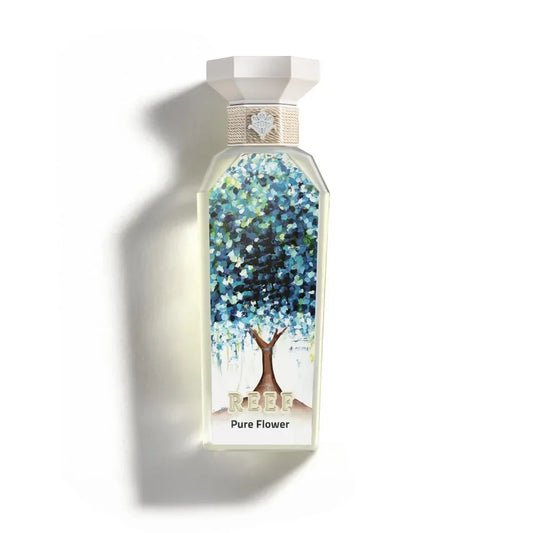
If a fragrance fades faster than you would like, changing how you apply it often helps more than changing the fragrance. See how to make perfume last longer, where to spray perfume and how many sprays to use. For how the Reef range compares in general terms, see how long every Reef lasts.
FAQs
Why does the same perfume last longer on some people than others?
Skin type is a major factor. Oilier skin tends to hold fragrance for longer than dry skin, and body heat, hydration and what you have put on your skin all play a part.
Does spraying more perfume make it last longer?
Somewhat, since more product puts more fragrance on the skin. It also increases projection sharply, which is a common reason a scent feels too strong in enclosed spaces.
Is projection or longevity more important?
It depends on the setting. Moderate projection suits an office, while an evening out can suit more, even if the fragrance does not last as many hours.
Ready to compare? Use our compare tool or browse Reef.