What Is Oud? A Beginner’s Guide to Arabian Perfume’s Signature Note
If you’re new to Arabian perfumery, “oud” is the word you’ll see everywhere — and it’s worth understanding, because it’s the backbone of nearly every great Middle Eastern fragrance, including much of the Reef range.
What Oud Actually Is
Oud (also spelled “oudh” or “aoud”) is a resin that forms in agarwood trees when they’re infected by a specific mould. The tree responds by producing a dark, fragrant resin to defend itself — and that resin is what gets distilled into oud oil. Genuine agarwood oud is one of the most expensive raw materials in perfumery, which is why most commercial fragrances use oud accords (synthetic or blended recreations) rather than the pure oil.
What Oud Smells Like
Oud is hard to describe to anyone who hasn’t smelled it — it’s woody, but also smoky, leathery, and slightly animalic, with a warmth that sits somewhere between incense and old leather. Quality and style vary hugely by origin (Cambodian, Indian, and Malaysian oud all smell noticeably different), which is part of why no two “oud” fragrances smell quite the same.
Why Arabian Perfumes Lean on It So Heavily
Oud has been central to Gulf perfumery for centuries, traditionally burned as bakhoor (incense) as much as worn as fragrance. Modern Arabian-style EDPs — like several in the Reef range — use oud as a base note to add depth, warmth, and longevity that lighter, Western-style fragrances often lack.
How to Wear Oud Without Overdoing It
- Oud fragrances tend to be strong — 1-2 sprays is usually enough.
- They suit cooler months and evenings better than hot summer days.
- Oud blends beautifully with saffron, rose, amber, and vanilla — all common Reef pairings.
Where to Start
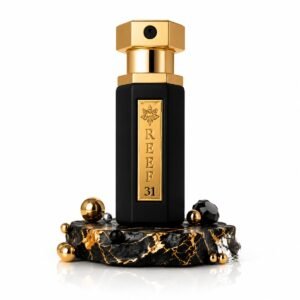
If you want to try oud without diving into the deep end, Reef 15 pairs oud with bergamot and lily for a gentler introduction. For the real, full-strength saffron-oud experience, Reef 33 is the range’s signature scent.
FAQs
Is oud the same in every perfume?
No — oud varies significantly by source and processing method, and most commercial fragrances use a blended “oud accord” rather than 100% pure agarwood oil.
Does oud last longer than other notes?
Generally yes. Oud is a heavy, resinous base note, so it tends to anchor a fragrance and extend its overall longevity compared to citrus- or floral-forward scents.
Is oud unisex?
Absolutely — oud has no inherent gender, and many of the best-loved oud fragrances (including several Reef scents) are marketed unisex.
How Oud Is Actually Made
Genuine oud production is slow and labour-intensive — infected agarwood is harvested, the resin-dense heartwood is separated out, and it’s typically steam-distilled into oil over many hours. This scarcity is the real reason pure oud oil is priced closer to gold than to a typical fragrance ingredient. Our full how Arabic perfume is made guide walks through the entire process, from harvesting to the finished bottle.
Natural Oud vs Synthetic Oud Accords
Because natural oud is so costly, most mass-market Arabian perfumes — including the majority of the Reef and Lattafa ranges — use carefully built oud accords: blends of synthetic aromachemicals (like ambroxan) and smaller amounts of natural oud extract, engineered to recreate the smoky, woody, leathery character convincingly at a fraction of the cost. This isn’t a lesser product; it’s standard industry practice, and it’s a big part of why a £30–£50 bottle can smell remarkably close to a £300 pure-oud attar. See our oud buying mistakes guide to avoid common misconceptions when shopping.
Oud Around the World: Why Origin Matters
- Cambodian oud — often considered sweeter and more refined.
- Indian (Assam) oud — typically deeper, earthier, and more intense.
- Malaysian oud — known for a brighter, slightly fruity edge.
Most commercial fragrances blend elements from more than one origin, or lean entirely on accords, so “pure single-origin oud” is rare outside specialist attars.
Best Oud Fragrances to Try Next
Ready to explore further? Our Best Oud Perfume UK guide ranks the strongest oud options across Reef and Lattafa, and our production guide has more on how concentration affects the final scent.
Related reading: our complete guide to Arabian oud